

Staff shortages and still getting the job done: invest in workplace happiness for increased productivity

The labor market tightness is at an unprecedented high, with more job vacancies than ever before. Since the outbreak of the pandemic, the job vacancy rate, the number of open positions per 1,000 jobs held by employees, has spectacularly risen to above 50. A figure never seen before. According to the Central Planning Bureau (CPB), which published its report in February 2024, there are no simple solutions to this problem.
Happier employees, higher productivity
However, getting the job done at work, or even doing more with fewer people? It’s possible if employees have a high motivation to engage with the organization. This is achieved when employees experience more happiness at work. There’s a progressive relationship: the happier someone is, the more productive they are at work. This could be a significant solution to staff shortages. Not easy, indeed, but it yields a lot.
Be sincere and authentic
The caveat here is that an organization will come up short if it (only) works on increasing employee happiness as a kind of trick to achieve better productivity. Only organizations genuinely and authentically committed to increasing employee happiness will ultimately achieve positive business results.
Tips for higher productivity
The findings of Professor Rosabeth Moss Kanter from Harvard University in 2013 reveal what sets the most motivated and productive employees apart from others. This higher productivity arises because motivated employees:
are more effective, with an average improvement of 17% (Forbes magazine research); have lower absenteeism, up to 40% (Gallup research firm); have lower turnover, also up to 40% (Gallup research firm); and consequently, there is less productivity loss in training new colleagues.
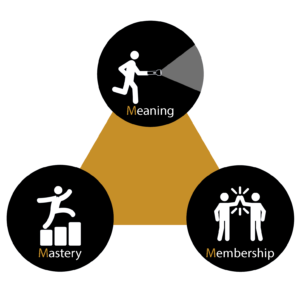
3M’s: Meaning, Mastery, Membership
The professor identified 3 essential elements, the 3M’s, to work on: Meaning, Mastery, and Membership.
Teams can use this principle of the 3 elements focusing on the fundamental needs and motivations of employees to increase happiness at work and thus achieve positive business results. I’ll outline them below.
Meaning: what it means for organizations
Meaning arises when you can contribute to a greater purpose. Organizations and teams must repeat and reinforce this. Emphasize especially the positive impact of the work employees do.
Be clear about how products or services can improve the world. An inspiring mission and vision provide guidance for employees’ priorities and decisions.
An employee who experiences a high level of meaning in their work might say:
- I make a meaningful contribution to the organization where I work.
- Through my work, I contribute to a better world.
- The organization’s mission and vision inspire me.
- I am proud of the organization.
Actions to experience more ‘Meaning’:
- Increase contact with the end customer (or resident, patient, client, or citizen) by offering shadowing days, internships, or temporary job swaps. This way, the employee knows who they’re working for.
- Set long-term goals as a team that are meaningful and challenging, for which employees are willing to get out of bed and put their shoulders to the wheel together.
- Make the organization’s products and services also available internally to employees. Think of free financial advice for bank employees or an annual career conversation for employees of a career advisory firm.
- Increase references to meaning in the physical workplace, such as photos, artworks, attributes, colors, visible successes, and results.
Mastery: what it means for organizations
Mastery grows when employees develop more in-depth skills. Provide positive feedback and feedforward (determining the next step, what the employee needs to do to achieve the set goals) in a positive way within the team.
Set challenging development goals together and ensure appreciation so that employees keep learning continuously. Involve employees in innovations and keep checking together if work can be done smarter, faster, and better.
An employee who experiences a high level of mastery in their work might say:
- I develop myself in my work.
- The work environment enables me to achieve results.
- I can use my talents and qualities in my work.
- I receive positive feedback about my work.
- My work energizes me.
Actions to experience more ‘Mastery’:
- Hold regular 1-on-1 conversations, preferably once a month. Also, conduct a stay conversation with team members: why do you stay with this team? If you were to receive an offer from another company, what would they need to offer to interest you?
- Actively job craft within the team, so everyone’s talents are better utilized.
- Provide self-insight to team members, utilize talents, and provide opportunities to utilize talent.
- Involve the team in innovation and improvement and use their insights and ideas.
- Show appreciation and recognition to each other. According to research (Smarp), this is the most important factor influencing productivity. Nearly 70% of employees are willing to work harder if their leaders appreciate their efforts more (Hubspot).
Membership: what it means for organizations
Membership grows when employees feel part of a (work) community and have a strong bond with a community. They long to be accepted and respected, to feel that they can be who they are, and to feel emotionally connected to colleagues. They share matters that matter, even if they are outside the work sphere.
An employee who experiences a high level of membership in their work might say:
- I feel accepted and appreciated.
- I have good contact with my colleagues.
- I feel supported by my team and my manager.
- I discuss personal matters with colleagues too.
Actions to experience more ‘Membership’:
- Invest in getting to know each other better as team members. Consider including this as a fixed part in meetings, during onboarding, at the start of a project group, on the intranet, and in 1-on-1 conversations.
- Facilitate communities around shared interests of employees. This can be done by providing facilities, sponsoring, or creating time and space.
- Increase opportunities for informal conversations, for example, before and after meetings or around the coffee machine.
- Celebrate successes with the team, for example, with applause, a gift, or pastries.
- Plan fun activities with your team, even if there is understaffing. This can be a brief moment as part of the workday or a special meeting, or a half-day where you do something fun together.
- Select coaching leaders for the team. Employees often commit more to leaders with whom they have built a good relationship.
